

Windfall earnings from energy trading have allowed BC Hydro to avoid large rate increases, while reporting record profits. But it looks like the party’s over.
Introduction
BC Hydro’s latest annual report, for the year ended March 31, 2026 (F2026), shows a net income of $721 million, the highest figure since F2010, and possibly an all-time record.
This was only possible because BC Hydro is subsidized by profits from Powerex, BC Hydro’s energy trading subsidiary. Net income would have been a mere $40 million were it not for a $681 million adjustment from “regulatory balances”.
And the government-mandated rate increases of 3.75 percent in each of F2026 and F2027, while more than the rate of inflation, would have been considerably higher without help from Powerex.
It’s time to take a closer look at these energy trading profits, and see what may be in store.
Rate smoothing
Public utilities such as BC Hydro don’t charge market prices. Instead, their rates are set by the BC Utilities Commission (BCUC), which allows them to collect their costs plus a fair return.
The BCUC can allow a utility to smooth out rate increases if there is an unusual spike in costs, making it easier for customers to adapt to them. The extra costs are deferred for a while, and so long as the deferred balances aren’t allowed to build up too much, the interest cost (which customers pay for) is relatively small. The BCUC should independently assess the costs and benefits of rate smoothing before allowing a utility to defer costs.
But sometimes governments override the BCUC, and order that BC Hydro’s costs should be deferred for reasons of its own. One could speculate that it may be politically inconvenient to increase electricity rates in the runup to an election, for example.
When the previous Liberal government starting deferring BC Hydro’s costs in 2013, it ended with the incoming NDP government bailing out the utility to the tune of $1.1 billion (it helped that the NDP had a budget surplus at the time – remember those?).
Trade income
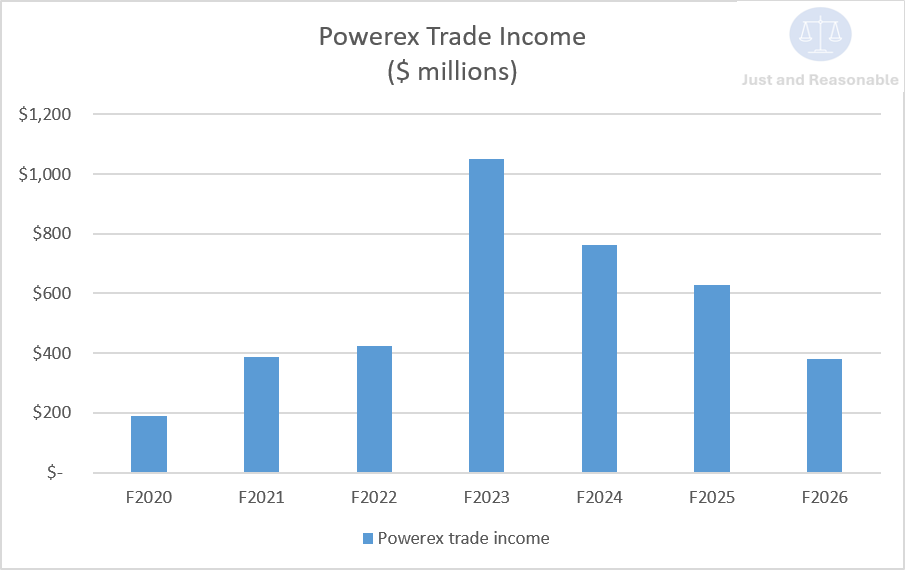
Fortunately for the government, Powerex has been making record profits (known as Trade Income) in recent years, peaking at over $1 billion in F2023:
Source: BC Hydro reports to the BCUC
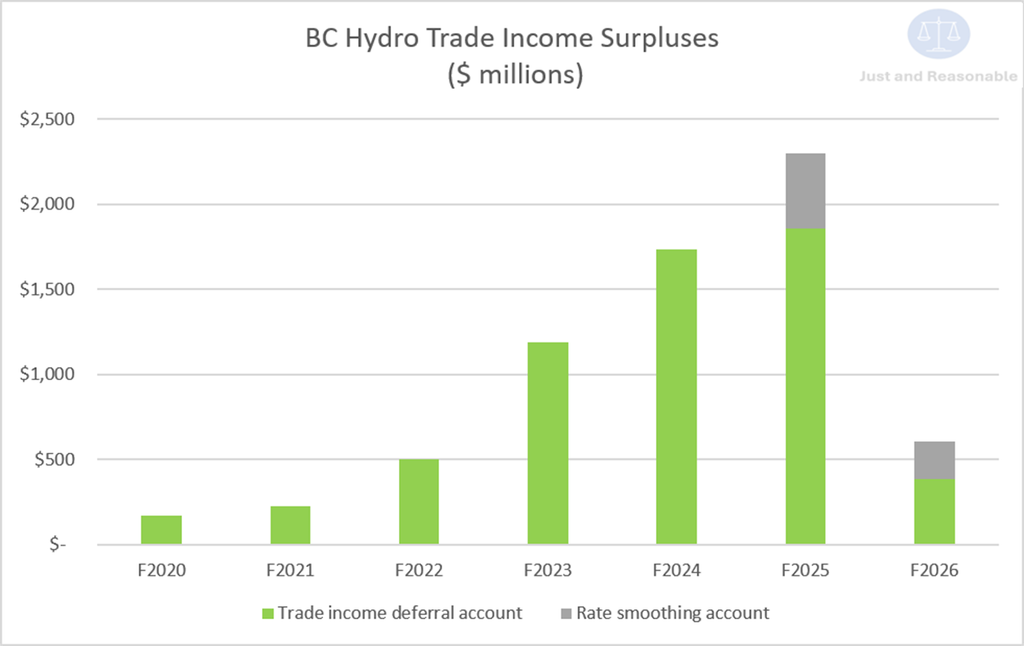
Trade Income subsidizes electricity rates, and any surplus profits are stored in BC Hydro’s Trade Income Deferral Account. BC Hydro also socked away $446 million of surplus Trade Income in a Rate Smoothing Account in F2025.
The combination of these surpluses peaked at $2.3 billion in F2025:
Source: BC Hydro annual reports
Down to earth
Sadly, however, the latest annual report suggests the party’s over. Much of the accumulated surplus has been used to keep rate increases down to 3.75 percent in the last two years while allowing BC Hydro to record its record profit.
The “extraordinary market conditions” that led to Powerex’s record performance in F2023 are now considerably more ordinary – profits are now back to the level they were prior to F2023. Moreover, not only was there no surplus last year, Powerex earned less profit than BC Hydro had built into rates, which further reduced the accumulated surplus.
At the same time, BC Hydro’s expenditures are increasing much faster than inflation. Its costs for personnel, materials and external services and amortization have risen by a total of 40 percent in the last three years. Along with other expenses for the new John Horgan (Site C) Dam, BC Hydro estimated rates would have had to rise by 8.3 percent last year to cover its costs.
Plus, BC Hydro has been spending billions on unplanned imports because the drought reduced its ability to generate electricity. While things improved somewhat last year, imports were still the primary cause of BC Hydro spending $304 million more than planned on energy.
All of this has conspired to use up the accumulated Trade Income surpluses that might sustain BC Hydro’s net income in future, and keep customers’ rates lower.
Conclusion
The government has been lucky. The windfall profits from Powerex arrived at the same time as the drought hit and Site C came online. The government avoided having to use taxpayer funds to bail out BC Hydro, and doing the hard work of controlling its costs.
Unfortunately, it looks like its good luck has run out – by the end of this current year the accumulated Trade Income surpluses will probably be gone.
The cost of imports may be coming down as the drought comes to an end, but nothing is being done to control BC Hydro’s operating costs. An attempt by the BCUC to manage these cost increases was abandoned by the new BCUC chair soon after he was appointed (by the government that owns BC Hydro).
It seems the government doesn’t have the stomach to challenge BC Hydro’s cost increases. In the longer term, it is probably counting on increased demand for electricity to reduce rates through economies of scale. But if the government wants to keep rates affordable in the short term, as it claims to, its options are limited.
Unless Powerex reverts to its “extraordinary” performance of F2023, this government must surely be tempted to follow the path laid out by its predecessor, and keep electricity rates artificially low by deferring BC Hydro’s costs into the future.
Only this time, there will be no handy budget surplus to bail out BC Hydro’s ratepayers.