

Cuts to spending on pipeline safety have thankfully been reversed. But the Utilities Commission’s squeeze on PNG’s operating costs highlights the regulator’s special treatment for BC Hydro.
Introduction
Pacific Northern Gas (PNG), which serves central and northern BC, is the province’s second largest gas utility, after Fortis Energy Inc. (FEI). Both utilities are regulated by the BC Utilities Commission (BCUC).
Despite PNG being tiny compared to FEI (a little over 40,000 customers compared to over one million), it still deserves to have rates set using sound regulatory principles and procedural fairness.
The recent BCUC process to set PNG’s rates was messy, to say the least.
Background
PNG operates as two utilities: PNG-West serves around 20,700 customers in northwestern BC, including Terrace, Kitimat and Prince Rupert. Its subsidiary, PNG (NE), serves another 21,700 customers in the northeastern of the province.
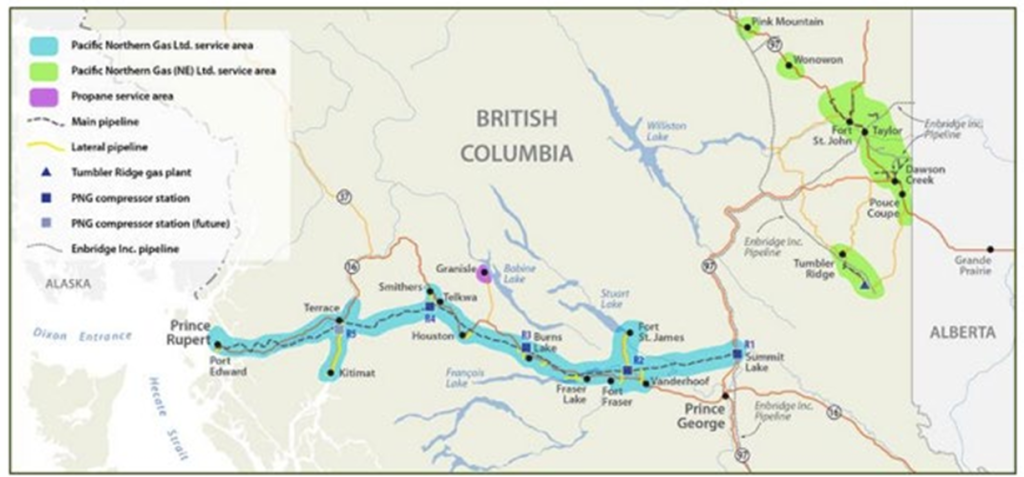
In April 2025, PNG applied to the BCUC for rates for the years 2025 to 2027.
PNG-West’s application in particular raised some eyebrows, with bills for residential natural gas customers expected to rise by 22.9, 24.6 and 4.2 percent for the three years (before taking into account the effect of cancelling the provincial carbon tax).
The rate increases PNG (NE) applied for were smaller, but the corresponding bill increases for the three years would still be 9.1, 7.5 and 7.6 percent respectively in Dawson Creek, for example (Fort St. John and Tumbler Ridge customers have slightly different rates).
There were some historical reasons for PNG-West’s large rate increases, but it’s not surprising that the BCUC’s inquiries targeted PNG’s costs.
Capital error
The BCUC’s aim was slightly off, however. It directed PNG to reduce its spending on pipeline safety, provoking a reconsideration of the decision and an implied rebuke from a fellow regulator.
The BCUC denied 50 percent of PNG-West’s proposed $45 million capital spending for “integrity management”, testing to ensure that gas pipelines are safe and fixing any defects. It also directed PNG (NE) to reduce its integrity management capital expenditures by 50 percent in both 2026 and 2027.
PNG-West requested a reconsideration of the decision to cut its safety investments, claiming the cut materially increased its “safety, reliability, operating and compliance risk”. PNG provided an email from the BC Energy Regulator (BCER), which regulates the safety of PNG’s high-pressure pipeline system, expressing concern about the reduced funding, and requiring the utility to complete engineering assessments to determine “the impact of deferred activities on the integrity of the pipeline system”.
PNG (NE) claimed that reducing its safety spending would lead to “heightened risk of intervention or enforcement orders from the BCER and may impact its ability to provide safe and reliable service to its customers”.
Faced with this opposition, the BCUC relented, and reinstated the applied-for safety budgets. It denied it had erred in its original decision, but accepted the “new evidence” from the BCER.
If the cap fits…
The BCUC was more successful with its attempts to rein in PNG’s spending elsewhere.
PNG-West was denied an $8 million budget “placeholder” to fix some specific “geohazard risks”. The BCUC was right to deny this request as there was insufficient justification to build it into rates right away. PNG can still apply to spend that money in future if and when it’s really needed.
More questionable was the BCUC directive to limit increases in PNG-West’s operating, maintenance, administrative and general expenses to 2 percent per year (the BCUC says utility had requested increases of 3.42, 3.05 and 6.25 percent for 2025 – 2027 respectively).
For one thing, the 2 percent figure was arbitrary, with no evidentiary basis. The best the BCUC had to offer was that adjustments and corrections identified during the proceeding would keep the likely increase below 2 percent in 2025 anyway. They made no comment on 2026 or 2027.
The 2 percent figure is also pretty stingy – FEI, whose rate increases are also capped, was authorized to use an inflation figure of 4.198 percent for 2025. There’s a risk PNG-West will not collect enough in rates to recover its operating costs, on which it doesn’t earn a profit anyway. If that happens, PNG’s shareholders are at risk of picking up the tab.
The introduction of PNG’s cap was procedurally suspect too. The idea seems to have appeared in the BCUC’s final decision without having been discussed during the proceeding, leaving no opportunity for PNG-West or the interveners to question it.
Utilities should always try to contain their costs, even if their rates are not rising, and the BCUC should always pay attention to costs. But the BCUC’s statement that it “expected PNG to take more decisive and specific actions to contain, or even reduce” these expenses given the “steep, upward pressure” on rates, makes the 2 percent cap on increases sound punitive.
I’m surprised PNG didn’t ask the BCUC to reconsider this part of the decision as well. They may regret leaving the precedent unchallenged if the BCUC decides to impose further arbitrary caps on future years’ rate increases.
Conclusion
It’s appropriate that the BCUC scrutinizes PNG’s proposed expenditures. For rates to be just and reasonable, expenditures should be what’s necessary to deliver safe and reliable service, but no more than that. Capital expenditures deserve especial scrutiny, since this is where utilities earn their return, and where they have the biggest incentive to exaggerate their needs.
But the regulator needs to be reasonable too. It should follow due process, and allow utilities the opportunity to make a return. Simply capping operating expense increases at an arbitrary (and possibly insufficient) level doesn’t feel right. The 50 percent cuts to safety expenditures were particularly egregious.
This aggressive scrutiny of PNG’s expenditures was hypocritical, too. Long-time readers will no doubt recall my disappointment (and lack of surprise) when the BCUC abandoned its attempts to control BC Hydro’s costs. The use of performance-based rates could have saved millions of dollars, as it did for Fortis’s ratepayers.
The BCUC seems keen to make utility shareholders take the risk of managing their costs, unless of course that shareholder is the provincial government.