
New modelling shows BC Hydro needs to double the amount of electricity it currently generates by 2050, but it’s not clear how this could be done safely. The BCUC should insist the utility be more transparent about its plans.
Introduction
BC Hydro’s electricity shortages have become more serious of late. The utility is now expecting to be short of both energy and capacity (the ability to serve peak hour demand) by 2030. With long lead times to construct new generation, BC will probably be reliant on imported electricity.
But BC Hydro’s longer term shortages are different. While the expected deficits get much larger by 2035 and beyond, there is still time to build new generation to meet growing demand – if they act soon enough.
But how much electricity do we need?
A missing piece of the puzzle
Utilities like BC Hydro are required to produce long-term plans, typically with a 15-20 year horizon, which are reviewed by the BC Utilities Commission (BCUC). The BCUC’s guidelines require utilities to consider different forecasts that “illustrate a reasonable range of potential outcomes”. The “high demand” forecast is usually the most critical, as having too little energy available for customers is much worse than having too much.
In its 2021 Integrated Resource Plan, BC Hydro presented a high demand forecast, but it was by no means the highest possible demand the utility could reasonably face. It did not include sufficient electricity to achieve the legislated greenhouse gas (GHG) emission reductions, nor the electricity required by customers of the proposed North Coast Transmission Line (this was presented separately). BC Hydro’s current (2025) Integrated Resource Plan was no better in this respect.
Now, however, a piece of this puzzle has fallen into place. In a recent filing to the BCUC, BC Hydro has provided for the first time a forecast of how much electricity it would require to meet the government’s climate goals.
Electrification forecast
BC Hydro hired Navius, a local consulting firm, to create this forecast. They included all the likely electrification required to decarbonize BC’s economy, including electric vehicles, heat pumps and the like in order to meet both the 2040 and 2050 GHG emission reduction targets. It does not appear that Navius included additional demand from North Coast Transmission Customers in its forecast.
Even with all the energy it anticipates from its 2024 and 2025 calls for power, BC Hydro would still have a deficit of around 37,000 gigawatt hours (GWh) of energy by 2050:
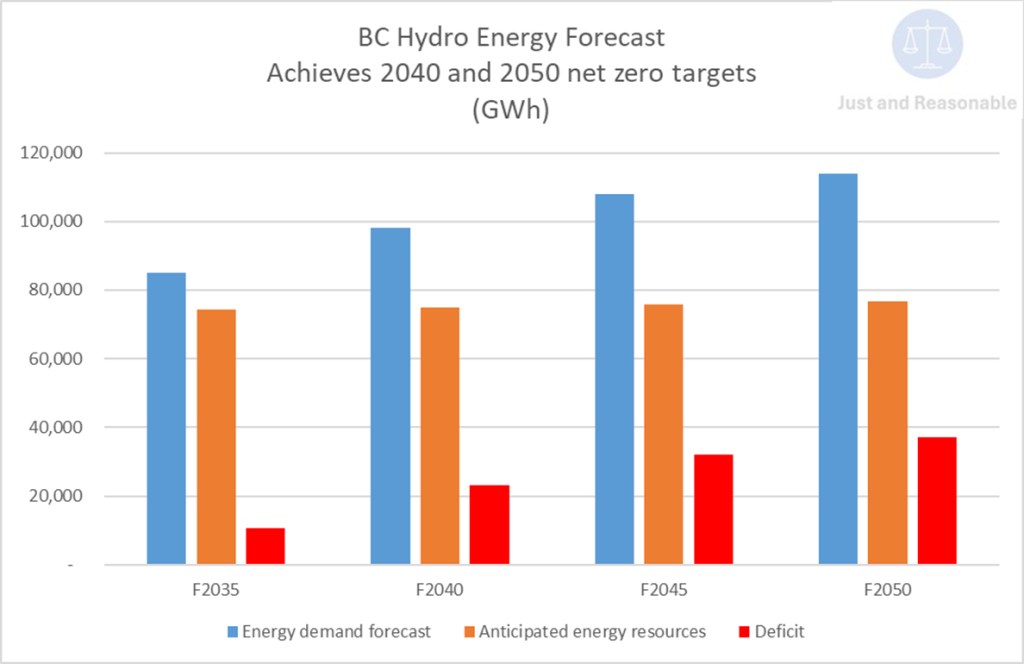
To put that in perspective, it would take about seven more Site C dams-worth of electricity to plug that deficit.
The idea of building seven new Site C dams seems far fetched, to say the least. It may also not be necessary. BC Hydro’s Integrated Resource Plan suggests there is plenty of energy available from wind and solar generation.
BC Hydro has now had two calls for power, where it provides 30-year contracts to the private sector to build new generation, mostly wind but with some solar. Each call for power will add up to 5,000 GWh per year of generation, and it appears that further calls could add tens of thousands of GWh more, with lead times of five to eight years before electricity starts flowing into the grid.
Limits to growth?
Unfortunately, this energy is all “intermittent” – it can’t be fully relied on to generate energy when it’s needed at times of peak demand (winter evenings). BC Hydro estimates it can only rely on 24 percent of the energy from onshore wind at peak times, and can’t rely on solar at all.
There are additional reliability risks to adding too much intermittent generation. Last year’s blackout in Spain and Portugal that left 60 million people in the dark is an example. While it was not caused directly by their heavy use of wind and solar energy, it appears that the system overall was not well adapted to such high levels of intermittent generation.
At a recent presentation by two senior BC Hydro planners, it was clear that they were well aware of the dangers of adding too much intermittent generation to an electricity system not designed for it. However, it also appeared that they had not reached a conclusion on how much intermittent energy could safely be added to BC Hydro’s system, at least without other changes.
BC Hydro has taken steps to add more firm capacity in the next decade, including proposals to add a sixth generating unit in Revelstoke. Even with these improvements, BC Hydro forecasts a deficit of around 5,000 MW of firm power by 2050 to achieve the government’s climate goals:
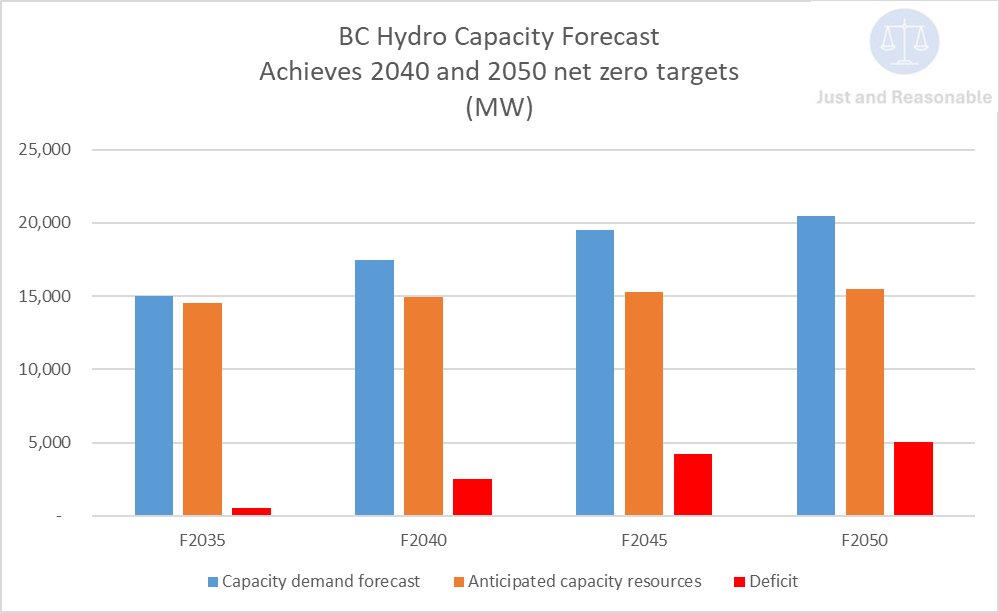
To plug these gaps, BC Hydro has initiated a call for “expressions of interest” to provide it with firm capacity. Similar to its earlier calls for power, BC Hydro is looking for private sector companies or First Nations to provide the facilities. Unlike the calls for power, however, BC Hydro isn’t soliciting bids yet – this is just to “test the market” and see what’s out there and how long it might take to build.
BC Hydro claims this process has been successful, to the extent that it has received “106 submissions representing 19 gigawatts of potential new electricity capacity”. While it’s unlikely any of these options will help with the 2030 deficit, they could start to be useful from 2035 onwards.
However, BC Hydro’s 2025 Integrated Resource Plan doesn’t specify the types of new generation that could meet this level of demand (never mind adding even more to serve North Coast Transmission Line customers). Even the plan’s recommendations of new generation to meet its high demand forecast, which won’t achieve the climate targets, show large amounts of unspecified “future resources” starting as early as F2032.
Conclusion
The Navius forecast confirms what has long been assumed – BC Hydro is going to need a lot more electricity to meet the legislated GHG emission reduction targets on the way to net zero by 2050. What’s still not clear is how this can be achieved.
The BCUC rather timidly accepted BC Hydro’s 2021 Integrated Resource Plan, overlooking its lack of specificity and other failings. This time around, there have been some encouraging signs the BCUC might take a firmer line – it rejected BC Hydro’s request to delay the proceeding for a year, and it was a question from BCUC staff that prompted the filing of the Navius forecast (which had been in BC Hydro’s possession since February 2025, by the way).
It’s not good enough for BC Hydro to say that its choices “will ultimately be determined in future [integrated resource plans]”. To have confidence that the 2025 Integrated Resource Plan is in the public interest, the BCUC should insist that BC Hydro say specifically how it would provide enough electricity to meet the legislated GHG emission reduction goals, without risking system reliability.