The provincially owned electric utility has stopped reporting on its compliance with provincial climate objectives. This is poor for transparency, but might be good politics.
Introduction
Ever since 2011, BC Hydro has reported on its compliance with government climate targets. The utility published how much electricity it generates from clean sources, such as hydro, wind or solar. And every year, it met or exceeded the legislated objectives for clean generation.
The 2026 annual report, published this month, brings this fine example of public sector transparency to an end – the report no longer includes how much of BC Hydro’s electricity is clean, or whether the utility is compliant with provincial energy objectives.
The loss of transparency is a problem; we should be told whether the provincially owned utility is meeting these objectives.
But does this change in reporting signal a bigger change in direction for BC Hydro?
The story so far
The 2010 Clean Energy Act set out BC’s energy objectives. Among them, 93 percent of electricity generated in BC was to come from “clean or renewable resources”.
To show its compliance with this objective, BC Hydro started reporting how much of its generation was clean, a practice that continued unchanged until 2022. It wasn’t a perfect measure, as the utility also imports electricity in addition to its own generation. But at least the measure was reported consistently.
In 2022, BC Hydro modified its performance measure, introducing what it called the Clean Electricity Standard. This raised the bar from 93 to 100 percent clean energy, and included all electricity used in the province – imports as well as local generation. The Clean Energy Act was modified some months later to adopt the same standard as its objective, to be achieved by 2030.
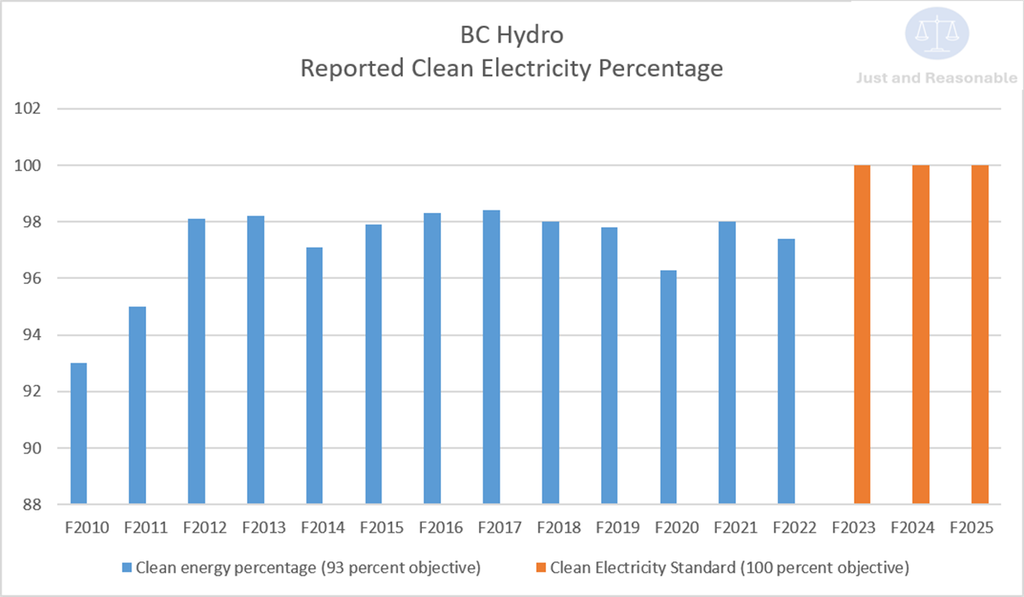
BC Hydro’s reported results against these objectives from 2010 to 2025 are shown in the chart below:
Source: BC Hydro annual service plan reports
The improvement from 2010 to 2012 coincides with government restrictions on the use of Burrard Thermal, BC Hydro’s gas-fired plant in the Lower Mainland, which started in 2009.
The increase to 100 percent clean electricity from 2023 onwards bears closer inspection, however.
The Clean Electricity Standard
In its February 2022 Annual Service Plan, BC Hydro said that introducing the Clean Electricity Standard would make its power “even cleaner.” And lo, it came to pass. Despite the new objective appearing harder to achieve, the very next year BC Hydro went from generating 97.4 percent clean electricity to meeting the new 100 percent standard.
There were reasons to be skeptical about this sudden attainment of perfection.
For one thing, results from 2023 onwards no longer represented data for just one year. BC Hydro chose to average its performance over multiple years, to “balance annual variations in load and hydrology”, whatever that means. This multi-year average is not mentioned in the Clean Energy Act definition of the Clean Electricity Standard, by the way – BC Hydro just made that up.
BC Hydro also repeatedly changed how it calculated its results. The 2023 results used data from four years, 2021 to 2024, with the latter two years presumably being forecasts of BC Hydro’s choosing. But the following year, it claimed it didn’t have four years of data, and chose the years 2021 to 2023. By 2025, it was back to using four years’ data: 2021 to 2024.
This all looks a bit fishy to me. It would look a lot less suspicious if only BC Hydro were willing to share how the figures were calculated.
But BC Hydro claims not to have the calculations, saying they were done by Powerex, its energy trading subsidiary, which is conveniently beyond the reach of the Freedom of Information and Protection of Privacy Act. This doesn’t inspire confidence.
Blackout
Notwithstanding any doubts about the calculations, BC Hydro was consistently claiming to achieve the 100 percent Clean Electricity Standard. It burnished their environmental credentials, and those of the government. It was an easy win.
Then, in March 2025, BC Hydro quietly dropped the Clean Electricity Standard as a corporate objective. The utility no longer reports its compliance with the province’s objective for clean electricity, despite being owned by the province, directed by the government that set the objective in 2024, and being the only utility that could actually make any difference towards achieving it.
The big question is: why?
The most obvious answer is that BC Hydro doesn’t think it’ll meet the Clean Electricity Standard in future, and doesn’t want that disclosed. Better to be criticized for saying nothing than to say something embarrassing.
And where is the regulator in all this? The BC Utilities Commission (BCUC) appears to have shown no interest in examining BC Hydro’s compliance with the provincial clean electricity objective. Yet when an environmental group complained about gas utilities’ compliance with provincial rules on renewable natural gas, the BCUC leapt at the chance to launch an inquiry. Some might consider this a double standard.
Conclusion
This is poor governance all round. We should have the right to know how well the publicly owned BC Hydro is doing against the legislated standard for clean electricity.
Discretion might be good politics, however.
The Clean Electricity Standard was introduced in 2024, at the peak of environmental influence over BC Hydro (the Minister of Energy at the time was the former Green Party mayor of Tofino). Since she was replaced in late 2024, and the new Minister took on responsibility for climate action as well as energy, we’ve seen a swing back to a more balanced position.
Not long after the change in leadership, BC Hydro modified its “strategic goals” to remove references to “clean power” and “climate action targets”, and replaced them with a goal of meeting “growing customer demand.”
We’ve since seen BC Hydro extend two agreements to buy electricity from gas generators, one of which it is now buying. These deals maintain reliability in a growing electricity system, but were almost unthinkable under the previous Minister.
None of this is popular with environmentally minded voters, I’m sure. The next election has to be by October 2028, but could be much earlier if the government decides to take advantage of the current disarray in the opposition party and a possible “rally round the flag” effect of the current trade war with the US.
Abandoning the Clean Electricity Standard was one way to keep any increase in BC Hydro’s fossil fuel generation, or imported electricity, out of the news.
I’m not criticizing the government’s renewed focus on growing a reliable electricity supply. It’s likely to be good for the economy and jobs, even if there may be some sacrifice to BC’s progress on climate action.
I just wish they would be more transparent about it.