


BC Hydro’s claim to have met its 100 percent clean electricity goal is not supported by the evidence. It should be more transparent if it wants the government’s electrification strategy to be credible.
Introduction
In its 2024/25 annual report, BC Hydro proudly states:
“With 98% of our electricity in B.C. coming from renewable sources, electrification offers consumers and industry a pathway to grow the economy and reduce carbon emissions”.
Electricity is indeed a critical element in the government’s climate strategy. To have any hope of reducing greenhouse gas (GHG) emissions by 80 percent by 2050, the legislated target, much of our economy must be electrified. But this strategy only makes sense if the electricity we’re using is clean.
BC Hydro measures its environmental performance against what it calls the “100% Clean Electricity Standard”, and claims to have met that standard in 2024/25. But unlike in previous years, it did not provide a specific percentage of how clean last year’s electricity was.
It turns out that some data on BC Hydro’s GHG emissions are publicly available, and they raise big questions about just how clean our electricity really is.
Facilities’ emissions
The Industrial Facility Emissions Report (Emissions Report) provides the annual GHG emissions from industrial facilities in BC, most recently from 2023. These include BC Hydro’s generating plants, and its transmission and distribution facilities.
The Emissions Report uses calendar years, whereas BC Hydro’s annual report appears to use fiscal years when reporting on its Clean Electricity Standard performance (although it’s ambiguous), but the numbers still give us a good indication of what’s going on.
GHG emissions from BC Hydro’s own facilities have been quite variable over the last decade, but generally trending downward. An increasingly large percentage of the emissions comes from BC Hydro’s gas-fired generation facility in Fort Nelson – clean that up, and the 100 percent clean electricity target would be pretty much in the bag.
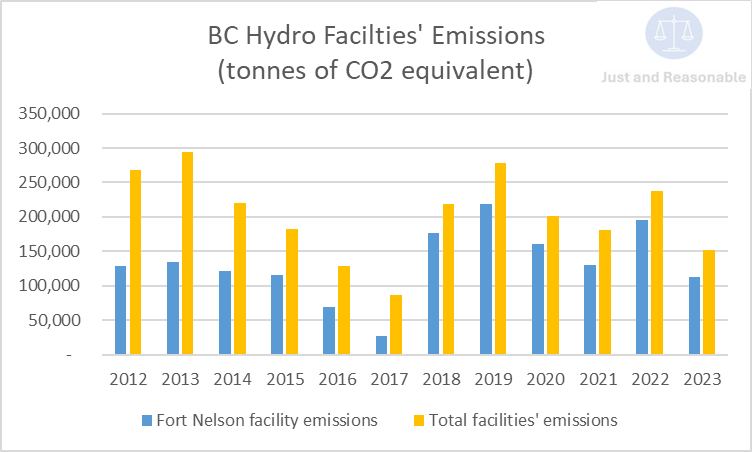
Or maybe not. The chart above only shows emissions from facilities located in BC. What about those imports?
Emissions from electricity imports
The Emissions Report also includes GHG emissions associated with imports. Although they’re not accounted for in BC’s emissions reporting, they absolutely dwarf those from BC Hydro’s own facilities:
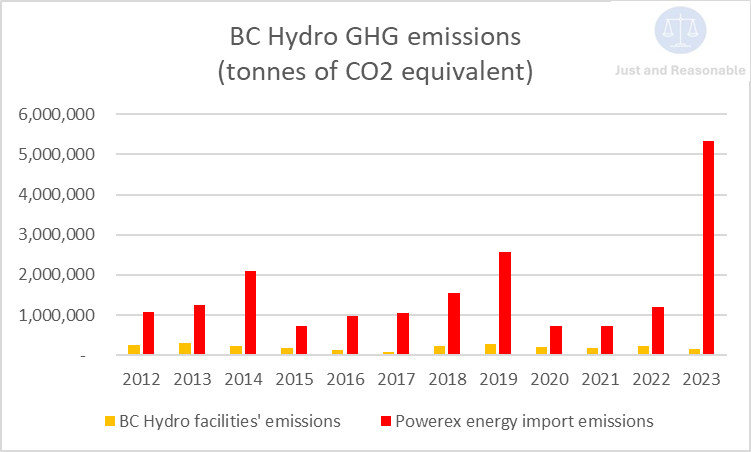
Since 2012, emissions from imports have averaged about eight times the emissions from BC Hydro’s provincial facilities. This is not surprising; I understand a good deal of imported electricity comes from the Southwest Power Pool, 53 percent of which was generated from coal or gas in 2024. But 2023 was a particularly bad year for imports, presumably because of the ongoing drought. Emissions from imported electricity were 35 times larger than those from the domestically-generated variety.
In 2023, there were 5.4 million tonnes of CO2 emissions related to BC Hydro’s electricity imports. To put that in perspective, that’s almost half the figure for the entire upstream and downstream oil and gas industry in the province (12.4 million tonnes).
By relying on electricity imports, we are effectively exporting our climate problem to the US, because emissions are counted where the electricity is generated. Ironically, to the extent the electricity is generated from natural gas (28 percent in the case of the Southwest Power Pool), we’re probably exporting the fuel too.
Own goal?
In claiming to have met the 2024/25 clean electricity standard, BC Hydro allows itself to look over a “four calendar year period” (without specifying which four years). This leaves a lot of room for mischief. For example, if BC Hydro didn’t achieve its 100 percent goal last year, could it still say it had “met” the goal just because it hoped to import more clean electricity in the next three years to make up for it? I think that would stretch the definition of having “met” the target a little thin.
But this could be why BC Hydro has stopped providing the percentage figure of exactly how clean its electricity is. Publishing a figure less than 100 percent would raise awkward questions, and undermine its claim to have met the standard.
Lack of information
Bizarrely, BC Hydro claims it doesn’t even know how clean its electricity is.
In response to a freedom of information request, BC Hydro said it was unable to provide the calculations because that information is held by Powerex, its wholly-owned energy trading subsidiary. Apparently, if Powerex says the clean electricity standard was met, then that’s what goes in the annual report. This is a shocking abdication of responsibility on BC Hydro’s part.
The BC Hydro Chair and CEO both sit on the Powerex board, you would think they have enough influence to get the information if they wanted it. Is it possible they don’t want to know? Or don’t want you to know?
And if the Minister of Energy himself was curious, he could use Section 20 of the Budget Transparency and Accountability Act to require BC Hydro to give him the information for the ministry’s service plan report. Just saying…
Conclusion
You may choose to take BC Hydro at its word, and accept, without evidence, that its electricity was 100 percent clean last year.
I’m not ready to do that. There are sufficient reasons to suspect we’re being misled, and that BC Hydro is relying on fossil fuel-generated imports to meet today’s electricity needs, never mind any future expansion.
We need a full and transparent accounting of how clean BC Hydro’s electricity really is, including what happened to the electricity imported in 2023 that represented 5.4 million tonnes of CO2 emissions. Without that, it’s hard to have confidence that the government’s electrification strategy will help us achieve the province’s climate goals.