
From misleading government press releases to statistical revisions, it’s hard to be sure BC has made any progress at all reducing GHG emissions. And things are about to get worse.
Introduction
The BC government has one job when it comes to its climate change activities – reducing GHG emissions in the province. It has legislated GHG emission reduction targets that are clear and simple (although measuring progress towards them is not, as we’ll see).
BC’s targets, introduced in 2008 using 2007 as a baseline, are for GHG emission reductions of:
- 16 percent by 2025;
- 40 percent by 2030;
- 60 percent by 2040; and
- 80 percent by 2050.
To make sure things stay on track, the legislation requires the Minister of Energy to produce a Climate Change Accountability report, an annual report of actions taken, money spent and future plans (until recently it was the responsibility of the Minister of Environment and Climate Change Strategy).
A few weeks back the BC government released its 2025 Climate Change Accountability Report, which uses data from 2023 (the most recent available). The Report is long on activity and spending, but rather short on real achievements towards the legislated goal.
Let’s strip away the marketing brochure and take a look at what progress was really made. It’s the usual “good news, bad news” story, but with quite a sting in the tail.
First, the good news
Of the four sectors of BC’s economy that generate GHGs, three report emission reductions since 2007:
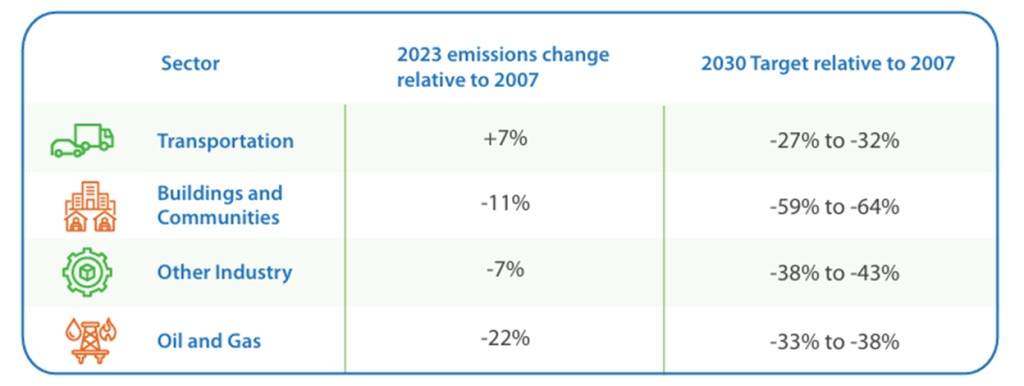
The star performer, ironically enough, is the oil and gas industry, which has made progress in electrifying upstream production and reducing “fugitive” methane emissions from equipment and pipelines. (In fact, emissions of methane, one of the most potent GHGs, have declined 48 percent since 2014.)
Up to a point, Minister
Looking at the economy overall, the government claims that:
“B.C.’s emissions are decreasing: Net emissions declined by nearly 4% in 2023, compared to the previous year, and are now 9% below 2007 levels.”
The government’s claim may be technically true, but it’s a tad misleading. BC’s legislated targets are not for “net” reductions in emissions, which include credits for “forest carbon offsets”, but for actual reductions. The figures used in the press release are not relevant to the government’s legislated target. The actual results, which were declines of 3 percent in 2023 and 6 percent since 2007, are rather less flattering.
Even the true reduction of 6 percent in emissions since 2007 is suspect, however. Like most government statistics, GHG emissions figures are subject to revision. What’s unusual is that the historical figures change every year, and show no signs of stabilizing.
Consider 2007, the baseline year for the legislated reporting and targets. The reported GHG emissions in megatons of CO2 equivalent (MtCO2e) for 2007 have changed every year since:
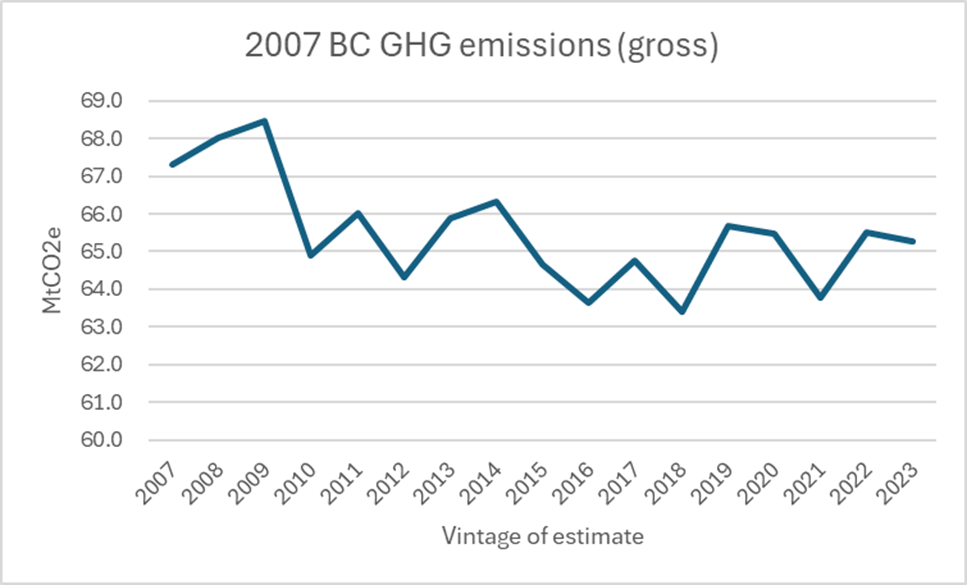
These revisions are intended to make the data more comparable year-on-year, but they suggest we don’t have a very reliable way to measure our GHG emissions. If we still don’t know what the emissions were in 2007, it’s unlikely we know what happened in 2023 with any accuracy.
And consider what it means if the 2007 baseline figure changes. If it’s revised downwards, which you can see has happened several times (including a reduction of 2.6 percent as recently as 2021), any improvements compared to the baseline could disappear in a puff of statistical smoke.
The Report says that there are now “early signs” our GHG emissions are decreasing. I’d like to share the Minister’s optimism, but I think we need more years of data to have any confidence that this is a trend, or even real. We shouldn’t get too excited about a one-year reduction of 3 percent.
Smoke gets in your eyes
In the grand scheme of things, all this may not matter much anyway. In 2023, BC reported record wildfire emissions of 369 MtCO2e – about six times the total emissions of every sector of the economy combined. 2023 was an exceptional year, but hardly unique. In 2018 wildfires caused three times as many emissions as the entire economy, and in 2017 it was 2.6 times. These emissions don’t count towards BC’s total.
This isn’t a good reason to do nothing about GHG emissions from the economy, but perhaps we should be more realistic about the advantages and impacts of reducing economic sector emissions.
Conclusion
The government admits BC is not on track to meet any of its upcoming GHG emissions reduction targets:
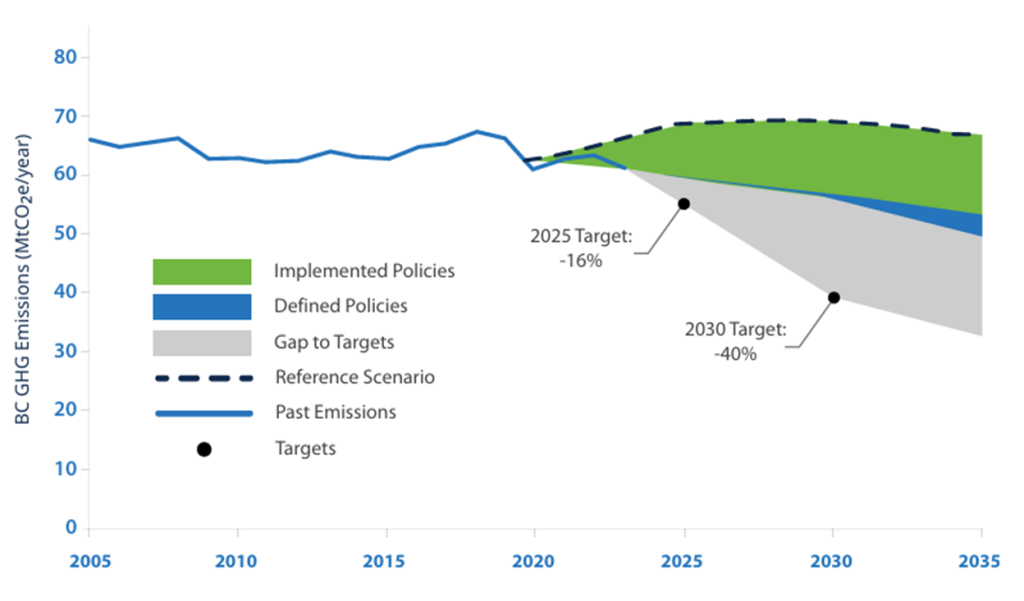
CleanBC, the government’s flagship climate program, has reportedly spent $7.5 billion since it got going in 2018. Sadly, even the minimal progress made so far will likely slow, if not reverse, however much public money the government throws at CleanBC.
There will be additional GHG emissions from new liquefied natural gas (LNG) plants coming onstream (LNG Canada started up in 2025; the current data only go as far as 2023), and the increased natural gas production to feed them. It’s unlikely that improvements in other sectors of the economy will be sufficient to offset these changes.
It’s also unlikely the government will do anything to risk the revenues it gets from the oil and gas industry, given the parlous state of BC’s public finances. The record 2026/27 budget deficit of $13.3 billion would be considerably worse without the $1.3 billion in natural gas royalties in the forecast. The emissions from those LNG plants and the associated extra production and pipeline transmission will be, at best, a secondary consideration.
As I wrote nearly two years ago, one legislated GHG emissions reduction target has already been abandoned (the 2020 target, abandoned in 2018). Surely legislation to abandon the current GHG emissions targets can’t be far away?