

No BC government has met a target in nearly two decades, and the new regime is putting a lower priority on solving climate problems. It’s time to end the charade and admit that reducing GHG emissions is a long-term ambition, and progress will be uneven.
Introduction
Since 2007, BC has had legislated targets for reducing greenhouse gas (GHG) emissions (all emissions targets in BC use 2007 as their baseline). The legislation requires the government to report on progress, if any, towards meeting the targets, and its plans to achieve them.
The initial targets, set in the Greenhouse Gas Reduction Targets Act and a subsequent ministerial order, were:
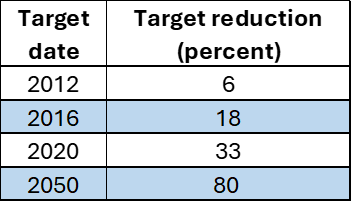
Note: All actual BC emissions figures used in this article are taken from the latest provincial inventory, which is current to 2023. Figures for prior years are restated every year, so to be consistent I’ve used only figures from this one source. Figures published in prior years (e.g. in earlier Climate Change Accountability Reports) will differ.
Progress so far
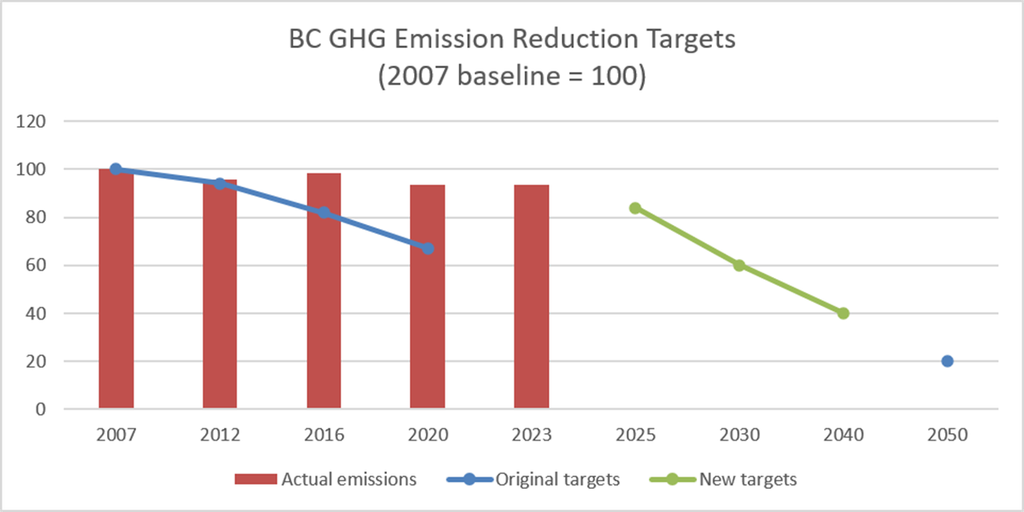
Things started out reasonably well. By 2012, BC’s emissions had been reduced by 4.3 percent, not too far from the 6 percent target.
But this progress didn’t last. By the time the Liberals left office in 2017, the trend was reversing, and the 2016 emissions (not revealed until 2018) turned out to be a mere 1.6 percent lower than the 2007 baseline, far from the 18 percent target.
The incoming NDP government, recognizing the 2020 target wouldn’t be achieved either, repealed it in 2018, and added targets for 2030 and 2040 instead (40 and 60 percent reductions respectively). An interim target reduction of 16 percent by 2025 was added shortly after.
The NDP also changed the name of the legislation to the Climate Change Accountability Act, as if this might somehow be a charm. It wasn’t.
The latest figures (2023) show emissions have actually increased slightly since 2020. The Minister of Energy admitted last year that we’re not on track to meet the climate goals.
New direction
The Conservatives’ pre-election plan indicates a rebalancing of priorities towards growing the economy and reducing the large budget deficit they inherited from the NDP.
There is no plan to reduce BC’s GHG emissions (although there is a reference to reducing global emissions, for example by exporting our natural gas to displace dirtier coal used elsewhere). Electricity generation will expand using “every available” source, which suggests an increased role for gas.
It’s a virtual certainty, then, that BC’s emissions will rise over the next few years, especially when you consider what’s already in the works. LNG Canada Phase 1 will add over 3 percent of 2007 emissions when it starts showing up in the 2025 figures, and Phase 2, announced recently, will add a further 3 percent or so by the early 2030s. No policy in place today will offset these increases.
This isn’t just a BC phenomenon. In June 2026, Prime Minister Carney gave forward guidance on his energy policy, saying [at around 13:20 minutes] that while his predecessor’s climate plan was “well-intentioned”, it was “not sustainable over the long term”, and that Canadian emissions will be higher in the next few years.
Ditch the short-term targets
We’ve never met an emissions target yet, and we’re even less likely to meet the ones for the next decade or so. Setting and resetting the short-term targets has become a charade.
Reducing GHG emissions in the province is a long-term ambition, requiring investment, innovation and, above all, time. Progress will not be linear, and will always be at risk of being blown off course by trade wars, recessions and the like.
So far, BC’s targets have either been abandoned when it became clear they won’t be achieved (2020), or simply ignored (2012, 2016). Let’s stop doing this.
The Federal government faces the same issue, by the way. Canada’s emissions have fallen 10 percent between 2005 and 2024, but our national targets are a reduction of 20 percent by 2026 and 40 percent by 2030. These targets will no doubt be repealed or ignored as well.
Given the new provincial government’s change in priorities, it would be more honest to drop the pretence of prior governments that GHG emissions reductions will receive special treatment over other public policy goals.
After all, we don’t have legislated targets for employment, wages, hospital waiting lists or traffic congestion, all things that governments profess to be concerned about on our behalf. Why should GHG emissions be any different?
Baby, bathwater
BC’s Climate Change Accountability Act contains both the emissions reduction targets and requirements for progress reporting. Even if we abandon the targets, progress reporting remains important. Fortunately, it appears the incoming government has no plans to abandon emissions reporting.
It does, however, plan to track emissions “accurately”. Specifically, it proposes to report on “emissions avoided through cleaner BC exports”, such as natural gas replacing coal used elsewhere. Also, forests will be counted as emissions offsets.
There’s no harm in providing more information, but this should be done carefully. There are internationally agreed-upon rules for climate reporting to provide standardized comparisons and avoid double counting. We should continue to produce the reporting we do today to ensure comparability, even if other information is added for greater context.
But if the Conservatives want to flatter the BC emissions figures with forestry offsets, they should be careful what they wish for. In 2023, BC’s 61 mega tonnes of GHG emissions were totally eclipsed by 437 mega tonnes of forest-related emissions, mostly due to wildfires.
Conclusion
It seems the incoming Conservative government plans to make changes to the reporting aspects of the Climate Change Accountability Act. They should take the opportunity to remove the climate targets as well, and save themselves the bother of resetting them each time we get closer to missing them.
And if they really are going to open up the Climate Change Accountability Act, they could also take a look at the requirement for the BC public sector to be carbon neutral. To take one random example, Vancouver Coastal Health reports it spent $1.1 million on carbon offsets last year to achieve carbon neutrality, money it doesn’t get to spend on healthcare. In today’s fiscal climate, this might be a luxury we can’t afford.