
BC Hydro has now spent $2.1 billion in three years on imports. Even if the drought ends, BC should consider being more self-sufficient in electricity.
Annual report
According to its 2025/26 (F2026) annual report to the BC Utilities Commission (BCUC), BC Hydro was a net importer of electricity for the third year in a row. The net $246 million spent on imports was less than the previous two years, but BC Hydro has now imported $2.1 billion of electricity in the last three years:
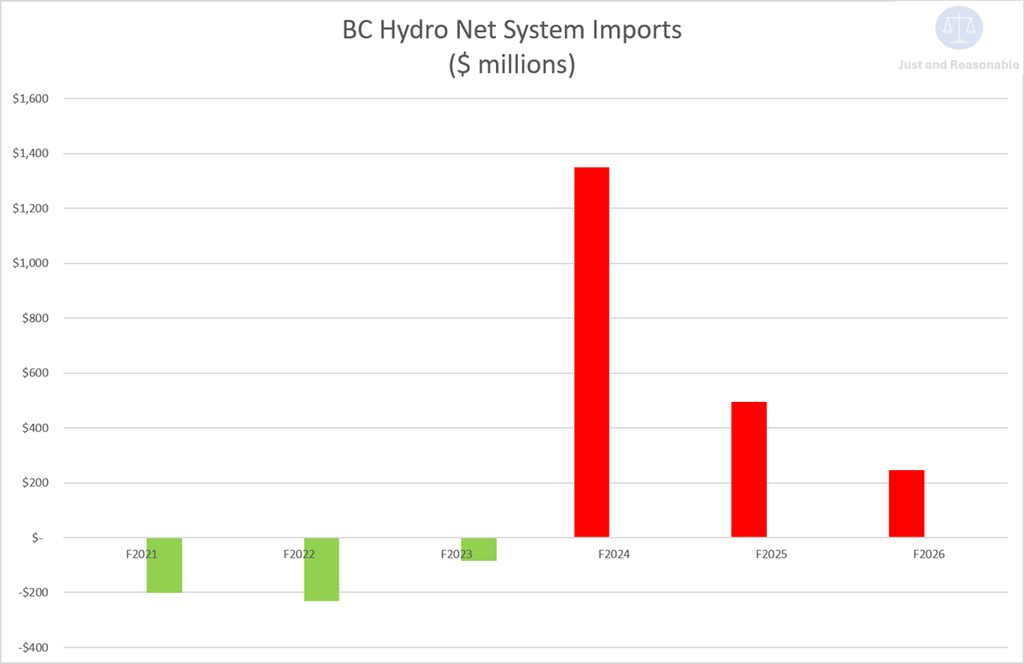
Despite the fiscal improvement, BC Hydro’s imports remain significant. The utility imported a net 4,344 gigawatt hours (GWh) of electricity last year, only slightly below the 5,100 GWh of energy available from the new John Horgan (Site C) dam.
The ongoing drought caused water inflows to BC Hydro’s reservoirs last year to remain below their historical average. The total energy stored in the reservoirs managed to be higher than average (we don’t know how much higher), but only thanks to the purchase of imported electricity.
Looking forward
The picture going forward is mixed at best.
On the positive side, the drought is easing in most parts of the province. The last provincial report shows that the snowpack, on which BC Hydro relies for much of its water inflows, was almost back to normal this year. In fact, for the Peace and Columbia river systems, it was 36 and 16 percent above normal levels respectively. This should be good news for BC Hydro’s generation in the next year, at least at its bigger generating stations.
It’s not all good news though.
The drought remains an issue on Vancouver Island, where snowpack in April was 56 percent below normal levels. The Island will increasingly rely on submarine cables to deliver electricity from the mainland, and on the natural gas generation plant whose contract BC Hydro renewed recently.
Worse, El Niño may throw a spanner in the works. This weather pattern is expected to begin affecting BC by the end of the year, and to be stronger than usual. Its warmer temperatures may bring lower snowpacks and earlier snowmelt in some areas, affecting water inflows. How electricity generation will be affected remains to be seen.
Self-sufficiency
The recent drought has shown that BC is reliant on others for its electricity. The Clean Energy Act’s self-sufficiency requirement has been watered down enough to make it effectively meaningless.
Much of the electricity we’re currently importing was generated from natural gas. And ironically, a lot of this gas was exported from BC in the first place, where there appears to be no shortage of the stuff.
BC’s Premier said at a recent trade war rally that we should “be our own best customer”. Rather than selling our natural gas to Americans and buying the electricity they generate with it, perhaps we should consider using it to generate our own?