
Only regulatory nerds with an appreciation for science fiction comedy need read any further. But a lot may be riding on this question.
Introduction
Douglas Adams’s sci-fi comedy classic, The Hitchhiker’s Guide to the Galaxy, opens with the demolition of the hero’s house. The municipal government responsible claims to have provided adequate notice, despite the plans being located in the bottom of a locked filing cabinet, in a disused lavatory, with a sign on the door saying “beware of the leopard”.
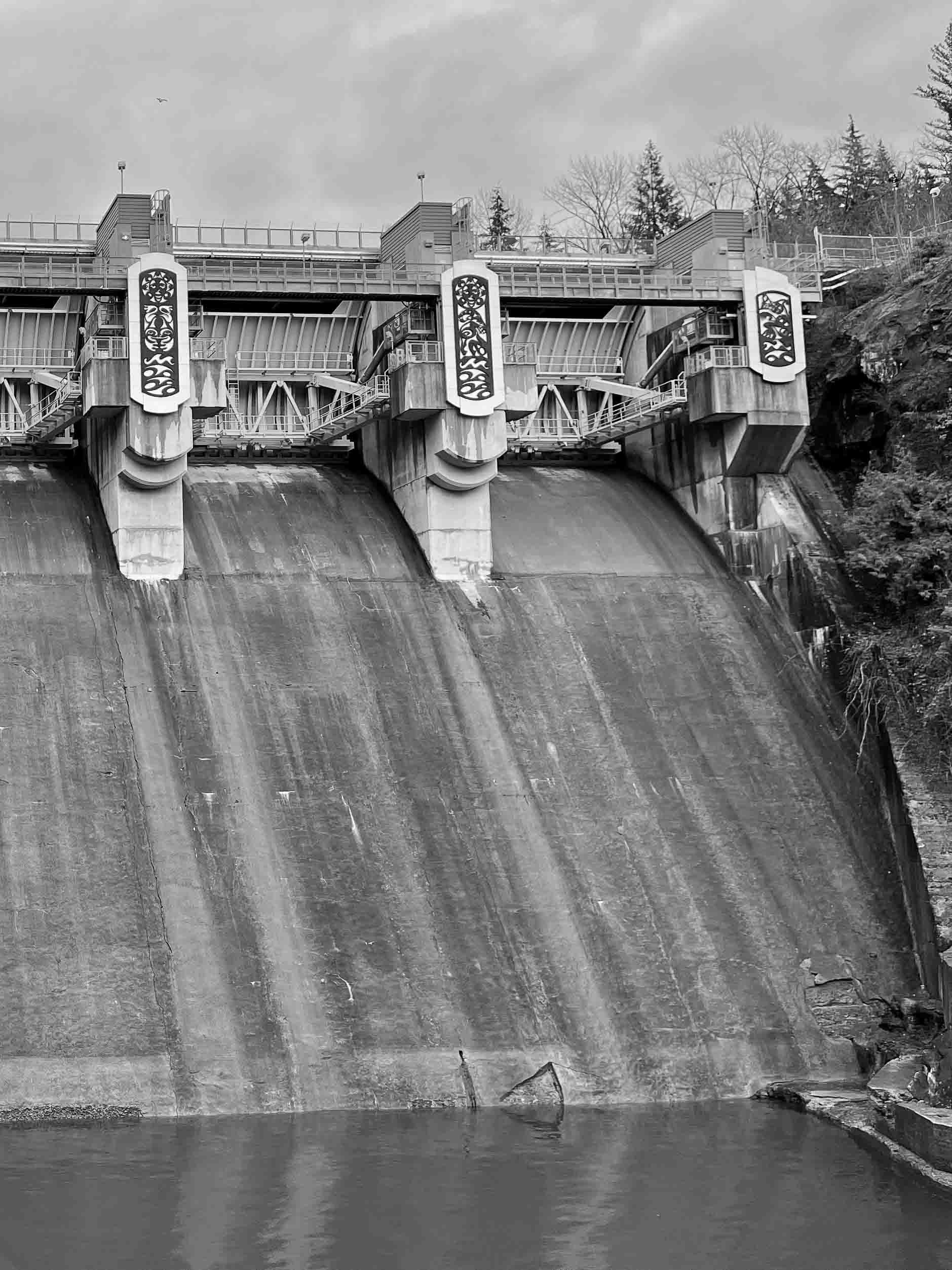
In the same spirit, BC Hydro announced in last year’s revenue requirements application, in a footnote, in an appendix, on the 98th page of a 776-page document, that it does not plan to seek the BC Utilities Commission’s (BCUC) permission to dismantle its Wilsey Dam and Shuswap Falls Generating Station (there are no references to leopards, I admit).
Joking aside, this would be a significant departure from past practice, and possibly a misinterpretation of the Utilities Commission Act. A response from the BCUC is pending. Here are my thoughts.
Mostly harmless
Despite last year’s BC Hydro revenue requirements application being a dead letter (the government ordered the BCUC to approve it), BCUC staff were paying attention, and questioned BC Hydro about the buried footnote. BC Hydro’s response made it clear they had a new interpretation of Section 41 which deemed BCUC approval unnecessary. Subsequently, the BCUC Chair initiated a proceeding to examine the matter
That was commendable. The BCUC could have simply swept BC Hydro’s footnote under the regulatory rug. Instead, the BCUC challenged BC Hydro’s assertion.
That said, the public notification for the proceeding was also very much in the spirit of Douglas Adams. BC Hydro informed eleven potentially-affected First Nations, but told no one else specifically about it. The only other notification activity was an “announcement” buried halfway down BC Hydro’s Regulatory Archive page (their version of a locked filing cabinet?), looking like this:

It doesn’t mention there’s an active proceeding underway, so despite the absence of wild animal warnings, it’s hard to see how this counts as adequate notification.
When BC Hydro actually wants people to know about a proceeding, it blasts out a social media campaign. At the very least, the BCUC usually insists that other utilities and intervener groups who may have an interest are notified individually, for example the ones who participated in BC Hydro’s previous revenue requirements application proceeding.
This lack of notification may come back to haunt the BCUC, as it could undermine the legitimacy of any conclusion they reach.
Anyway, BC Hydro made its final submission to the BCUC on July 7, so a decision should be imminent.
Here today, Vogon tomorrow
The BCUC’s question was quite straightforward: “whether BC Hydro requires BCUC permission pursuant to section 41 of the UCA to cease operation of the Wilsey Facilities”.
Section 41 of the Utilities Commission Act says:
“A public utility that has been granted a certificate of public convenience and necessity or a franchise, or that has been deemed to have been granted a certificate of public convenience and necessity, and has begun any operation for which the certificate or franchise is necessary, or in respect of which the certificate is deemed to have been granted, must not cease the operation or a part of it without first obtaining the permission of the commission.” (emphasis added)
BC Hydro has previously sought permission before ceasing operation of three similar facilities in recent years. In 2017, for example, the utility applied under Section 41 to cease operation of the Salmon River facility, which the BCUC approved.
BC Hydro’s position is that its previous requests made under Section 41 were based on an “incorrect interpretation”, which it is now seeking to correct.
In the past, BC Hydro has interpreted the phrase “cease the operation or a part of it” as referring to the operation of its electrical system. In other words, ceasing operation of any part of its system, such as a dam, requires permission under Section 41.
BC Hydro claims now that “cease the operation or a part of it” refers to its operation as a utility serving customers. Since it will continue to serve the same customers after demolishing the Wilsey facilities, it argues it is not ceasing anything relevant to Section 41, therefore it should not apply.
I agree with BC Hydro that Section 41 can apply to situations where a utility proposes to cease serving customers – this indeed requires the BCUC’s permission. However, I disagree with BC Hydro’s new interpretation that this is the only purpose of Section 41. In my view, Section 41 also requires utilities to obtain permission before ceasing to operate individual assets such as dams.
The regulator at the end of the universe
The Utilities Commission Act gives the BCUC oversight over all energy utility assets from their initial approval (Section 45 – Certificate of Public Convenience and Necessity) through construction (Section 47 – cease work orders) to their operation (Section 25 – safe and reliable service).
A recent BC Court of Appeal decision concerning a FortisBC gas pipeline in Coquitlam confirmed that the BCUC has jurisdiction over utility assets that have ceased operation, been abandoned and left buried underground. More on this case in a minute.
Even if the Utilities Commission Act didn’t explicitly give the BCUC jurisdiction over utilities’ decisions to discontinue using assets, which I think it does in Section 41, the BCUC has this power implied in the Act. It would not be consistent with the purpose and intent of the Act for the BCUC to have such a glaring gap in jurisdiction.
This jurisdiction is important for the BCUC to be able to protect the public interest. It requires the right to determine whether an asset like a dam should be taken out of service for the same reasons it has the right to approve whether it should be built in the first place. Utilities must demonstrate that the assets aren’t needed, that their removal would be done in an appropriate manner, that First Nations have been appropriately consulted, and that alternatives such as refurbishment were considered and properly discarded.
BC Hydro supports its argument with examples where the BCUC has allowed utilities to cease operation of assets without invoking Section 41. BC Hydro claims this demonstrates Section 41 applies only to cessation of customer service, and not to specific assets. The FortisBC gas pipeline referred to above is one such example.
In my view, however, these examples don’t prove what BC Hydro claims they do. In the FortisBC case, for example, the BCUC approved the decommissioning of a 20-inch gas pipeline without reference to Section 41 because it was being replaced by a newer 30-inch version. The function of the older pipeline was continued (and expanded). If the 20-inch version was simply being removed, I believe the BCUC would have required FortisBC to apply for permission under Section 41 before doing so.
Don’t panic!
In The Hitchhiker’s Guide to the Galaxy, the demolition of the hero’s house is followed by the demolition of planet earth. I’m sure BC Hydro has no such ambitions. Nevertheless, I would feel a lot more comfortable knowing that the BCUC still has the right to make sure the demolition of energy utility assets is in the public interest.
The BCUC, having challenged BC Hydro’s footnoted assertion, should now reassert its authority.