According to its environmental assessment application:
“FortisBC Holdings Inc. with its regulated natural gas subsidiary FortisBC Energy Inc. (collectively referred to as FortisBC) is proposing the Tilbury Phase 2 LNG Expansion Project (proposed Project) that includes construction of a new Liquefied Natural Gas (LNG) Storage Tank with a working volume of 142,400 cubic metres (approximately 3.5 petajoules), new liquefaction facilities with capacity of up to 7,700 tonnes per day of LNG production, natural gas receiving facilities, and supporting infrastructure. The existing Tilbury site includes the original LNG production and storage facility in operation since 1971.”
“The proposed Project purpose is to increase LNG storage for energy resilience in the Lower Mainland and increase LNG production to meet the need for LNG as a transportable and storable lower-carbon-intensity fuel. The proposed Project will also provide lower-carbon fuel to support local and global energy transition goals. The Tilbury facility has provided backup energy supply to British Columbians since 1971.”
“Following a public hearing, the British Columbia Utilities Commission (BCUC) provided approval to construct and operate the LNG storage tank component of the proposed Project and that it was in the public interest (Order C-6-25 and accompanying decision dated October 27, 2025), granting a Certificate of Public Convenience and Necessity (CPCN) to FortisBC Energy Inc. (FEI) for the Tilbury LNG Storage Expansion (TLSE) Project. In its decision accompanying Order C-6-25, the BCUC determined that the construction and operation of a 3-billion cubic feet (BCF) LNG tank and 800 million cubic feet per day (MMcf/d) of regasification capacity were in the public interest. The granting of a CPCN for the TLSE Project approves FEI to construct and operate the TLSE Project under the Utilities Commission Act and indicates that it is in the public interest for FEI to construct and operate the LNG storage tank.”
According to Section 8 of the application (climate change and greenhouse gas emissions):
“The proposed Project temporal boundaries are as follows:
Construction phase – Estimated 3- to 6-year duration
Operation phase – Estimated 40+-year duration
Decommissioning phase – Estimated 2-year duration
Construction is planned to commence as early as 2027+, with an anticipated proposed Project in-service date of 2030+.”
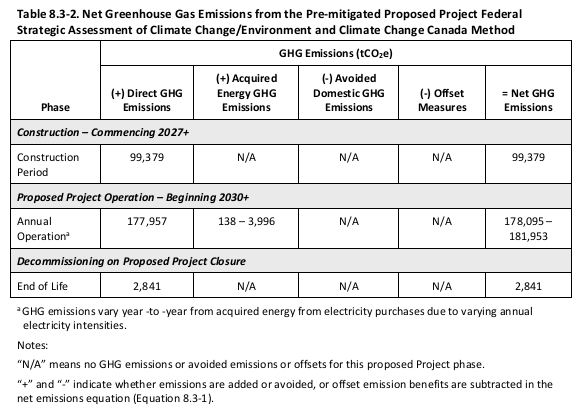
“The net emissions from the proposed Project for each phase using the methodologies from the SACC are shown in Table 8.3-2.”