
After a bureaucratic reshuffling, reports of CleanBC’s death might not be exaggerated.
Introduction
The Tyee recently reported that the BC government has “quietly eliminated its Climate Action Secretariat”, the group responsible for CleanBC, the province’s flagship environmental program. The campaign director from Stand.earth is quoted as saying this “puts the final nail in the coffin of CleanBC”.
The government, however, says this is just a “reconfiguration”, and that CleanBC remains “firmly in place”, now the responsibility of a new Climate Solutions Division. There was no response to the report that “at least 10” former staff members of the Climate Action Secretariat will “move to new subject matter, including supporting LNG [liquified natural gas], pipelines and gas fracking”.
What does all this mean for the future for CleanBC?
Soft power, hard cash
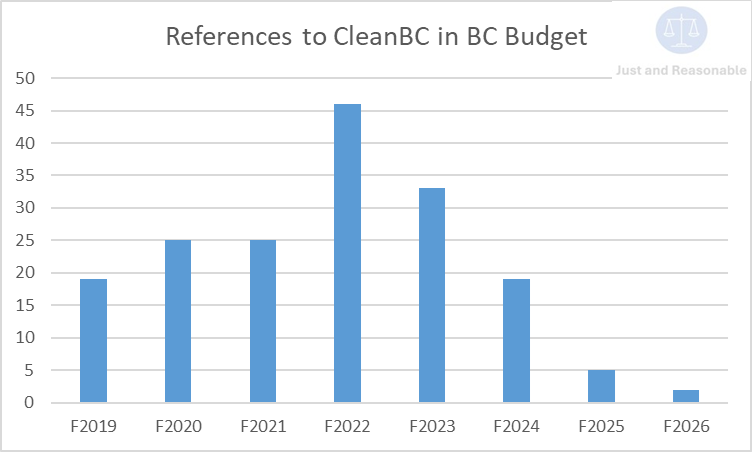
It seems that the government’s enthusiasm for dealing with climate issues has been on the wane for some time. There are a couple of ways of looking at this, starting with the prominence the program has (or rather, had) in the provincial budget. From its first mention in fiscal year 2019 (F2019), CleanBC references peaked in F2022, and have declined markedly since then:
It’s not just prominence, though. The spending of cold, hard cash also peaked around the same time. According to the government’s annual Climate Change Accountability Reports, climate spending (which includes CleanBC) peaked in F2023, and has been falling steadily ever since.
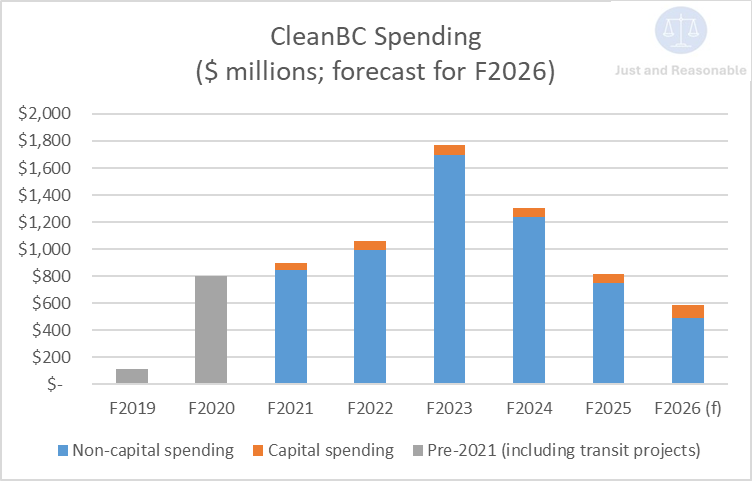
(spending on transit projects is excluded where possible as these distort the total, and in any case were dropped after the F2024 report)
Budget rollercoaster
So what accounts for the rise and fall in climate-related spending?
Certainly politics were a factor in its initial growth – the NDP only took power in 2017 thanks to a Confidence and Supply Agreement with the Green Party that gave them a majority in the legislature. That agreement required the NDP to “Implement a climate action strategy to meet our targets” – the “targets” presumably being the legislated greenhouse gas (GHG) emission reduction goals set out in the Climate Change Accountability Act.
After winning an outright majority in the 2020 election, the NDP continued the spending pattern until it increased dramatically in the bonanza year of F2023, the only year in recent history when the province forecast a budget surplus. It’s all been downhill since then, with forecasts of ever-growing budget deficits:
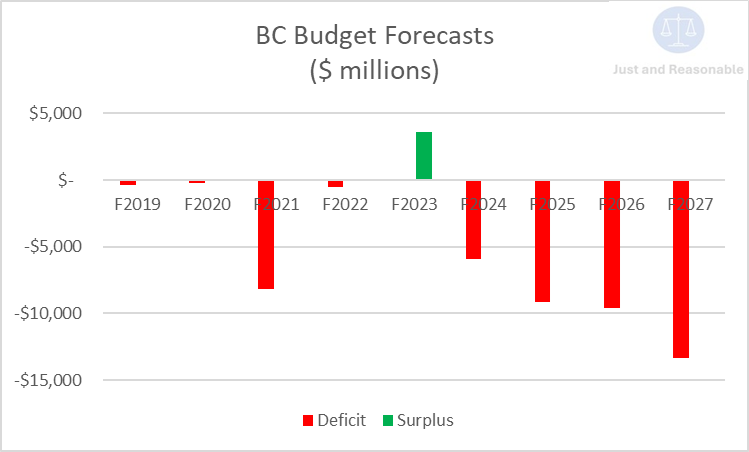
These budget deficits have caused the province’s debt to be downgraded by credit rating agency S&P Global five times in a row since 2021, falling to “A” from the top-rated “AAA” which the province had held for the previous 14 years.
Another indicator of budget health is the “interest bite”, the cents per dollar of revenue spent servicing the debt. This has risen from 3.1 in F2019 to 4.9 now, which is bad enough, but it’s forecast to reach 8.2 in F2029.
It’s no surprise that in this fiscal climate the government has trimmed its climate-related spending.
Where is this going?
In the same way that the deal with the Green Party stimulated the growth of CleanBC, the decline of the NDP’s ability to fund climate issues has hurt its relationship with the Green Party. In February this year the two parties ended a 2025 agreement citing “clear and growing” distance between them on policy issues, climate listed first among them.
While the NDP is no longer under any obligation to the Green Party to maintain climate spending, it will not want to risk losing too many voters who prioritize environmental issues. For this reason alone, I don’t think CleanBC will be abandoned entirely.
Still, its funding will continue to be curtailed as long as the outsized budget deficits remain. I share S&P Global’s negative outlook for the provincial finances, based on their view that the government’s actions to trim the deficit do not “reflect urgency”. CleanBC will be starved of funds for a long time to come.
Was it all worth it?
It’s not clear how much difference CleanBC was making anyway. The province has one climate goal: to reduce GHG emissions. In this respect it has failed spectacularly.
The legislated targets are for a reduction in GHG emissions by 40 percent by 2030 compared to a 2007 baseline, on the way to an 80 percent reduction by 2050. The original CleanBC Strategy claimed they had almost figured out how to do this, with just a few additional climate policies needed that could be added the following year. GHG emissions would fall, and the 2030 target would be met:
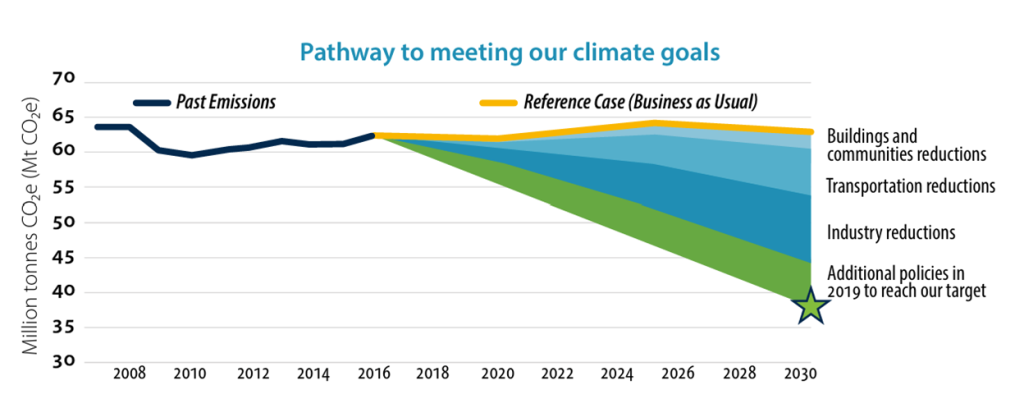
As it has turned out, this forecast was very wide of the mark. By 2023, the most recent year for which data are available, CleanBC had barely moved the needle on GHG emissions, which were still around the “reference case” level – i.e., what the government estimated would have happened if CleanBC had done nothing at all!
But CleanBC did do a lot – it spent around $4.5 billion up to F2023, according to the Climate Change Accountability Reports. While there may be some longer-term benefits to some of this spending, it has made almost no progress in seven years towards its one goal – reducing GHG emissions. The government has now admitted its current policies do “not put the Province on track to meet its 2030 targets”.
CleanBC review
Despite the lack of progress reducing GHG emissions, last year’s review of CleanBC claimed that it “is, for the most part, working”, a conclusion that, to put it kindly, is hard to reconcile with the evidence. Still, the review does correctly identify the expansion of LNG production as a source of additional GHG emissions in the province.
The report was effectively dismissed by the government, which politely said it would “review the recommendations as it considers next steps that continue to build a strong economy, cut emissions and prioritize affordability”. The reference to “strong economy”, coming as it does before “cut emissions”, is as clear a sign as you’ll get that LNG is a higher priority than climate for the NDP at present.
Conclusion
In January 2025, I predicted that government would do a better job of balancing economic growth with environmental issues. A year later, it was clear this had come to pass. The abandonment of the Climate Action Secretariat is a sign this trend is continuing.
The government needs to save every penny it can to try to restore some semblance of fiscal credibility. CleanBC has clearly been targeted for cost savings in the last three years, and with the budget situation continuing to deteriorate, this will surely continue.
On the revenue side of the ledger, LNG sector growth offers the possibility of construction jobs and increased provincial natural gas royalties (forecast to grow from $942 million to $1.6 billion by F2029). The government simply can’t afford to turn this away.
All of which means that, even if the CleanBC brand is retained, as I expect it will be, it won’t be doing much to reduce our GHG emissions. But at least it’ll be spending less money failing to achieve its targets.